Friday, 28 December 2012

Elements of a Thriller

                Macguffin, Enigmas and Red herrings 

A Macguffin is plot device that motivates the characters and advances the story, but has little other relevance to the story.

Alfred Hitchcock's quote on Macguffins: " We have a name in the studio, and we call it the 'MacGuffin'. It is the mechanical element that usually crops up in any story. In crook stories it is always the necklace and in spy stories it is always the papers.

Enigma refers to a puzzle, something mysterious or inexplicable, or a riddle or difficult problem. 
In thrillers, this is commonly something which the protagonist has to try to find out or solve before the narrative is resolved and the film finishes.

Red herrings is the name given to a device which intends to divert the audience from the truth or an item of significance. This can work with other devices such as enigmas to create suspense.
For example in Saw the two characters spend time imprisoned in a room in which a third character lies dead. Throughout the film, both characters appear to be guilty of a series of murders, until it is discovered at the end that the third person in the room is bot actually dead but is in fact, the killer.

Elements of a Thriller

                          Suspense and Shock


Alfred Hitchcock was a the master of suspense whose films came to be the benchmark for psychological thrillers.

Alfred's famous quotes about suspense in thrillers:

  • " There is no terror in the bang, only in the anticipation of it."
  •  " If i's a good movie, the sound could go off and the audience would still have a perfectly clear idea of what was going on."
  • " always make the audience suffer as much as possible"


       Suspense 'Thriller' - Hitchcock model

under the strong influence of Hitchcock, thrillers often begin with a crime and the accusation of  an innocent bystander. The accused contacts the authorities, no doubt the case could be promptly solved, but instead the poor bystander runs from the law thus further jeopardizing life and limb       - Rick Altman -

For example:
  • 'The 39 steps' - 1935
  • 'North by Northwest - 1959

"in 'The 39 steps': abandons both thrills and suspense when the falsely accused character finally reaches safety" - Rock Altman - 


Suspense refers to the audience knowing what the character in the film doesn't.
shock refers to an immediate event that occurs without warning:


Sound

             Sound: Diegetic/ Non-Diegetic 

  • Diegetic refers to the world of the text. for example : dialogue, sound effects, music with  a source within the text eg. a radio.
  • Non-diegetic refers to everything outside the world of the text, for example: voice overs, soundtracks, captions, titles and subtitles.

                Sound: On screen and Off screen

  • On-screen sound refers to when the audience can see the source of the sound. for example, in the scenario of a kitchen, the sound of a kettle would be an on-screen sound.
  • Off-screen sound refers to when the audience can't see the source of the sound. of-screen sound enables the extension of the diegetic world.

                Sound: parallel/ contrapuntal

  • Parallel sound refers to when the sound matches the actions in the scene
  • Contrapuntal sound refers to when the sound does not match the actions in the scene, a perfect example of that is in the opening of Jaws where the girls was being eaten by the shark and happy music was played:


My group's camera shot project


Thriller Analyses

                                 The Manchurian Candidate


The Manchurian Candidate by Richard Condon is a political thriller about the son of a prominent US political family who is brainwashed into being an unwitting assassin for the communist party.
There are two versions of the this film, one was made in 1962 and the other in 2004.
Both of the version had the same story line and a lot of similarities expect from the fact that the one that was made in 2004 was in colour as technology has developed a lot more in contrast to the 1962.

          Differences                              

The 1962 version is in black and white while the 2004 version is in colour

The 2004 version more ethnically diverse              
 
They didn't end in the same way    
  
 Instead of the leading actors on a fake grassy mound in a film studio (original film) the modern film has a realistic battle. CGI means that:
We have explosions, Night vision – making the attack seem believable                          


                 The Manchurian Candidate (1962)         

Directed by John Frankenheimer. With Frank Sinatra, Laurence Harvey, Janet Leigh.

The central concept of the film is that the son of a prominent, right-wing political family has been brainwashed as an unwitting assassin for an international communist conspiracy

In the scene where there was a dialogue between Eleanor and Raymond, when Raymond sat down the camera turned into an high angle with Eleanor so in the shot, making her look more dominant as she is trying to control him. In addition, while Eleanor is talking to Raymond, there is a dissolve into a scene with Raymond on his own thinking about it, then it goes further to a scene where Raymond is having a conversation with Ben: all of this occurred while we still have a dissolve of Eleanor talking to Raymond. This is very clever because it shows the pass of time and that these other scenes occurred because of what Eleanor said.


            The Manchurian Candidate (2004)

Directed by Jonathan Demme.
    With:
    Denzel Washington, Liev Schreiber, Meryl
Streep, Kimberly Elise.
    In the midst of gulf war soldiers are   kidnapped and brainwashed to idol Raymond Shaw,  in order for Raymond to win a high honour award.
In the scene when Ben (Denzel Washington) is being interrogated by the detectives, there were a lot of shot reverse shots  swapping from detective to detective meanwhile still keeping a shoulder shot of Ben looking towards the detectives. This is effective because if the camera is going from detective to detective, it shows that Ben is really being ganged up on by quite a vast amounts of detectives. In addition, there is a very quiet non- diegetic song of a a deep hum which adds to the tension in the atmosphere.


Thursday, 27 December 2012

Thriller Analyses

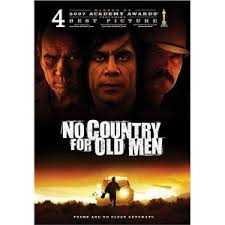
                              No country for old men: full analysis

Chigurh is a hired hit man who has no remorse or compassion for other human beings. It seems that he gains a warped satisfaction or enjoyment from killing or creating fear amongst others and this adds to the film’s tensions. This is demonstrated with the innocent shop owner when Anton pays for his gas and asks the man to flip his lucky coin to decide his fate.His main weapon of choice is a captive bolt pistol in which he uses to either kill people or shoot out locked doors. As an audience we know little about him due to his lack of speech.  What does this create?


The trailer for 'No county for old men' is very effective. one of the reasons for this is the long shots of open deserted sceneries at the beginning, this tells the audience that one of the features of the film is going to be isolation which is an element of a thriller. Another reason is when we were first shown the antagonist, the scene went quiet and on came a haunting non-diegetic sound. This tells the audience that this particular character is key to the film as there was a climax of sound as he was shown which is also an element of thriller.
I predict that the target audience for this trailer are teenagers because of the fast pace editing. suggest that the audience would have to be energetic , so are so able to keep up with the lively story   line.


At the beginning of the film, there is a voice over of the narrator talking about his history in the police force and criminal behaviour  which foreshadows that, that is what the film is going to be about.
the very first shot we get to see is a couple of long shots of the dessert which adds up to an establishment shot as we get to see different parts of the dessert. this creates a sense of isolation and remoteness to the scene as there is no characters around yet.

The costumes worn be the characters differentiates them in the case of innocence: the sheriff's costume is lighter which suggest purity whilst the antagonist's costume is very dark which suggests danger, importance: the costume worn by the sheriff is quite common while the antagonist's costume is dark and interesting which let's us focus more on the antagonist.

The fact that we were shown the antagonist immediately suggests that the film is straight to the point in contrast to other thrillers that try to convey suspense. This also reflects to the character of the antagonist, that he too is straight to the point, blunt and not afraid of anything.

The macguffin of the film is the money in the brief as the motive of the character was to get possession of it and it kept the storyline alive.

In the scene where the antagonists has a dialogue with Carson, low key lighting was used in the scene, there are no non- diegetic sounds or music used which builds tension. In addition, the shot reverse shot used adds to the pressure between the characters and then the telephone ring quite loudly which acts a shock element and makes questions like who is calling? why are the calling? is Carson safe? spring up in the audience's mind.

Tuesday, 11 December 2012

Thursday, 6 December 2012

Thriller Conventions

Thriller conventions are elements that makes up a thriller, such as:
  • central to plot: justice vs injustice, blurred line of good and bad, enigma, red herring , plot twist and cliff hangers.
  • sub genres: mystery, crime, psychological, political
  • moods: murder, menace, mystery, paranoia
  • characters on a dangerous mission, escape seems imppssible.
  • edge of your seats, tension, climax, suspense, pursuit and deadlines
  • society seen as a dark and corrupt 

Thriller opening

                                   Vertigo by Alfred Hitchcock


There was a very loud sudden non- digetic music that was being played which sounded taunting. Low-key lighting was used to portray the feel of fright that is being carried on by the music being played. there was a graphic match of the woman's eye to a hypnotic rotation of a sphere which suggests this might be a psychological thriller. The close  up of the unhappy woman's face is quite unappealing and frightening. 

Tuesday, 4 December 2012

Thriller opening

                                    No country for old men


At the beginning of the film, there is a voice over of the narrator talking about his history in the police force and criminal behaviour  which foreshadows that, that is what the film is going to be about.
the very first shot we get to see is a couple of long shots of the dessert which adds up to an establishment shot as we get to see different parts of the dessert. this creates a sense of isolation and remoteness to the scene as there is no characters around yet.

There is a pan to the police car; this pan introduces the characters and props and drags our attention to them. there is shot of the man putting the gas yank in the car and the camera focuses on it for quite a long time considering it's a prop, which tells us that this particular prop is going to be essential to this film. In addition, we get a long shot of the car approaching the very long highway: this suggests that something is wrong with the criminal that's in the police car as the camera was kept on them. As the car got further from the camera, the non-digetic  music builds up and creates suspense. when we get a medium shot of the police officer with the suspect behind him forebodes that something bad is about to happen.